
DISCHARGING, EVACUATING, CHARGING AND CHECKING — Points 1-4
HA-22prose procedurePoint-1 — Discharging
IMPORTANT
Slowly open the valves to discharge only refrigerant. If they are opened quickly, compressor oil will also be discharged.
Point-2 — Evacuating the System
Evacuating procedure
- 1Start pump, then open both valves and run pump for over 5 minutes.
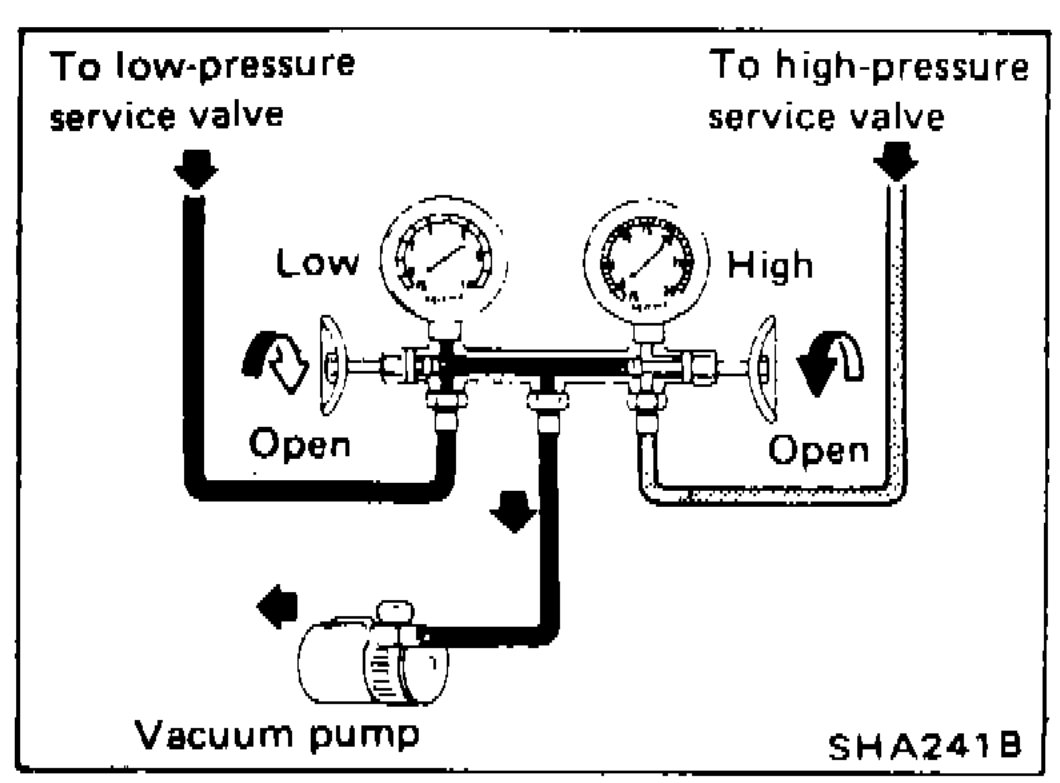 SHA241B
 - 2When low gauge has reached approx. 98.6 to 101.3 kPa (986 to 1,013 mbar, 740 to 760 mmHg, 29.13 to 29.92 inHg), completely close both valves of gauge and stop vacuum pump.
NOTE
(a) The low-pressure gauge reads lower by 3.3 kPa (33 mbar, 25 mmHg, 0.98 inHg) per 300 m (1,000 ft) elevation. Perform evacuation according to the following table.
IMPORTANT
(b) The rate ascension of the low-pressure gauge should be less than 3.3 kPa (33 mbar, 25 mmHg, 0.98 inHg) in 5 minutes.
Vacuum-of-system reading vs elevation
0 (0)
Vacuum of system* kPa (mbar, mmHg, inHg)101.3 (1,013, 760, 29.92)
300 (1,000)
Vacuum of system* kPa (mbar, mmHg, inHg)98.0 (980, 735, 28.94)
600 (2,000)
Vacuum of system* kPa (mbar, mmHg, inHg)94.6 (946, 710, 27.95)
900 (3,000)
Vacuum of system* kPa (mbar, mmHg, inHg)91.3 (913, 685, 26.97)
NOTE
*: Values show reading of the low-pressure gauge.
Point-3 — Checking Airtightness
Airtightness check
- 1Close both low and high-pressure valves and leave them unattended for approx. 5 to 10 minutes.
- 2Make sure the pointer of the low-pressure gauge does not deflect toward the "0" direction.
- 3If the pointer deflects, gas leakage is present. Repair as outlined under Point-4.
Point-4 — Repair
If a malfunction is noticed under Point-3 above, locate and repair the leaking point using the following table as a guide.
Leak location → likely causes
Leak at/around pipe connection
Likely causesO-ring fouled, damaged or deformed; Oil not applied to pipe connections during installation; Pipe connections not properly tightened (too tight or too loose)
Leak at/around gauge manifold
Likely causesMalfunctioning charging hose; Gauge improperly installed; Malfunctioning valve; Malfunctioning packing, etc.